Search for Lake Macatawa waterfront on one portal and you might see 47 active listings. Search again on another site the same week and the count drops into the 30s. Neither number is wrong. Both are incomplete in the same way, because the properties most worth knowing about on this lake often never touch a public listing site at all.
That gap matters more here than on most inland lakes. Lake Macatawa is a genuinely small market: roughly 1,700 to 1,800 acres of water, about 27 miles of shoreline split across three local governments, and a shoreline where many homes have stayed in the same families for decades. When something that scarce also tends to change hands quietly, the visible market stops being a reliable sample of the real one. If you're comparing Lake Macatawa to other West Michigan waterfront towns using nothing but portal counts and a headline median, you're working from a partial picture, and the missing piece is usually the expensive end.
The properties that skip the listing entirely
Above roughly $1.5 million on this lake, a different set of rules starts to apply. Agents who work the lake regularly describe a pattern where the most significant properties, particularly along South Shore Drive and in Pine Creek Bay, move through direct relationships between buyers and sellers before they're ever entered into the MLS. One agent tracking South Shore Drive specifically noted that typically fewer than five properties on that stretch come to market in a given year, and the most consequential of those often sell before a public listing exists.
Some of that is about privacy. A family that has owned a Pine Creek Bay estate for two or three generations is not necessarily eager to have showings scheduled through a portal inquiry form. Some of it is about thinness of comparables: when so few truly comparable sales exist, pricing a property well requires a level of judgment that benefits from discretion rather than a bidding war conducted in public. And some of it is simple math. As of February 2026, agents active on the lake were describing inventory for updated luxury waterfront, especially homes with deep-water dockage and strong sunset exposure, as historically tight. When buyers already know each other and already know the lake, a lot of the work of finding a match happens over phone calls, not search filters.
This is also where the Chicago connection shows up most clearly. Buyers relocating from Chicago and other metro areas have consistently been drawn to Lake Macatawa's relative value compared to coastal markets they already know, and that demand doesn't wait patiently for a listing to post. It gets ahead of it.
The Lake Macatawa you can search is real. It just isn't the whole lake, and the part that's missing tends to be the part with the best docks.
What your budget actually buys, address by address
None of this means the visible market is useless. It means a single median price for "Lake Macatawa" collapses several genuinely different markets into one number, and a buyer who understands the segments gets a much clearer read on where their budget actually lands.
| Segment | Typical starting price | What defines it |
|---|---|---|
| Near-water, no direct frontage | Low-to-mid $400,000s | Deeded or association beach access, no private dock, often set back from the shoreline |
| Waterfront condo with dock or slip | $150,000 to $500,000 | Association-maintained frontage, shared or assigned slip, lower-maintenance ownership |
| Channel-access waterfront | $700,000 and up | Direct frontage, private dock potential, boating access toward Lake Michigan |
| Prime estate frontage (South Shore Drive, Pine Creek Bay) | $3,000,000 and up | 200 or more feet of frontage, deep-water dockage, often multi-generational ownership |
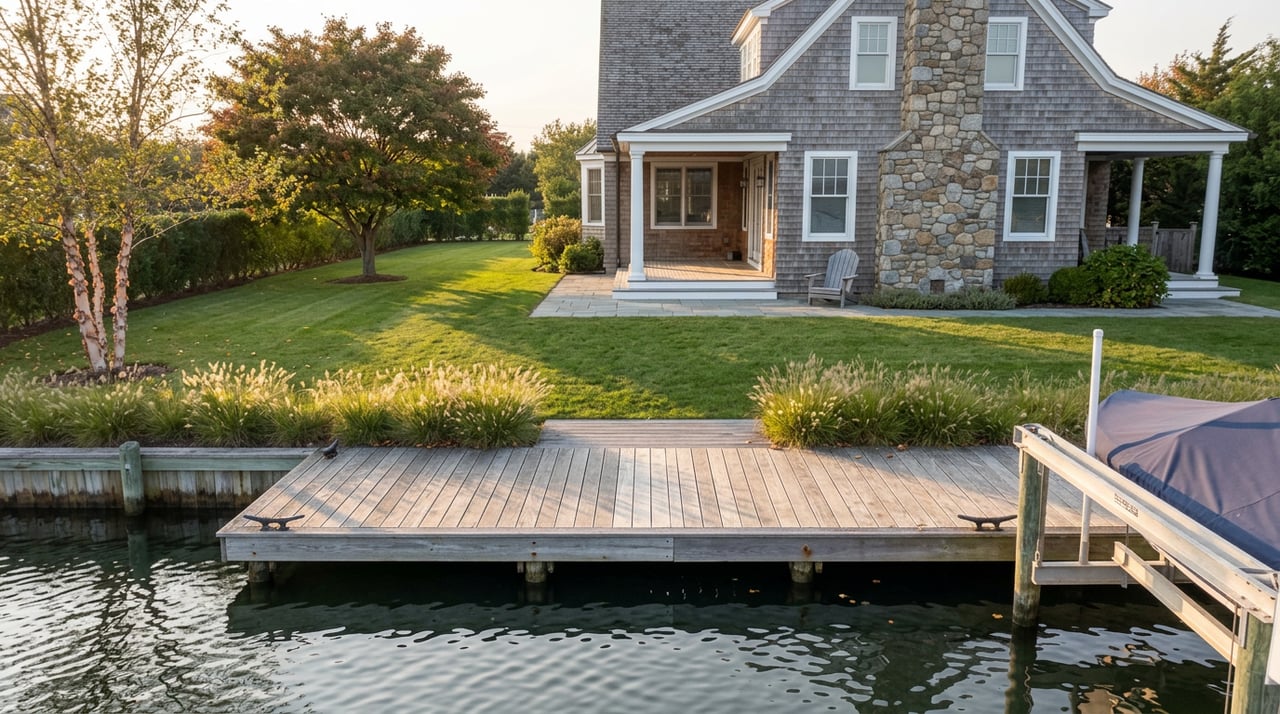
The neighborhoods behind those numbers each have their own character. South Shore Drive faces north across Big Bay, the widest stretch of open water on the lake, which is why afternoon sun and long sightlines toward the channel and Big Red Lighthouse command a premium there. Pine Creek Bay is the quieter, more protected pocket where privacy matters as much as square footage, and where estates with decades of ownership history rarely change hands in a way that looks like a normal sale. Macatawa Park, on the dune peninsula between Lake Michigan and Lake Macatawa, is a historic gated community built around cottages dating to the 1800s, with a vacation feel that holds year-round. Waukazoo Woods trades some of that prestige for a wooded, family-oriented setting closer to Holland's everyday conveniences. And newer communities like The Villas and The Reserve give buyers a lower-maintenance way into lakefront living, with community docks and amenities standing in for a private shoreline.
Two homes a few hundred yards apart on this lake can differ by hundreds of thousands of dollars depending on which of these categories they actually fall into, which is exactly why a blended median tells you so little on its own.
One lake, three governments
Buyers who assume Lake Macatawa operates under one set of rules run into a specific surprise during due diligence. The shoreline is divided among the City of Holland, Park Township, and Holland Charter Township, and each carries its own permitting process, tax rate, and local ordinance. A house on the east end near downtown Holland and a house on the west end near the channel can look nearly identical on paper and still sit under different rules for docks, short-term rentals, and property tax treatment.
Dock permitting is where this becomes concrete. Under Michigan's Inland Lakes and Streams Act, most new or replacement docks require a permit, and an existing dock being in place is no guarantee it was ever properly permitted in the first place. That history follows the property, not the previous owner's word. One active listing on the lake this year illustrates why that matters in practice: the sale includes an arrangement where several neighboring owners are jointly dredging a channel through a shallow stretch to reach deeper water, with the seller covering the dredging and permit cost, and the existing state permit set to transfer to the new owner with five years remaining. That is not a detail a portal photo will ever show you, and it is exactly the kind of thing that changes what a buyer should be willing to pay.
Speed rules add another layer. Under Ottawa County's watercraft controls, much of Lake Macatawa is a slow-no-wake zone within several hundred feet of shore, and enforcement near the marinas and yacht club is active. That's good news for a homeowner who wants calm water at the dock and less welcome news for a buyer picturing wide-open watersports every afternoon.
Before writing an offer on any Lake Macatawa waterfront property, a few checks are worth doing in this order:
- Confirm riparian rights and dock potential directly from the deed, not from the listing description.
- Pull the permit history for any existing dock and verify it against current state Inland Lakes and Streams requirements.
- Get a seawall inspection and a real repair or replacement estimate before it factors into your offer, not after.
- Check which of the three governing jurisdictions the parcel sits in and what that means for taxes and any rental plans.
- Review the FEMA flood zone designation, since insurance costs on this lake vary meaningfully by location.
What this means if you're comparing lakes
If you're weighing Lake Macatawa against Grand Haven, Spring Lake, or Saugatuck as a second-home market, the honest comparison isn't between headline medians. It's between how each market actually surfaces its best inventory. On a lake this small, with this much long-held ownership, the properties worth knowing about often require a phone call before they require a search filter. That's not a knock on the portals. It's just a reason to have someone on the ground who hears about a South Shore Drive estate before it ever needs a sign in the yard.
If you'd like a clearer read on what a specific budget actually buys across Lake Macatawa's different pockets, or you want early notice before something on your list ever goes public, reach out to Michigan Homes & Cottages to request your complimentary lakeshore marketing plan.
A couple of questions worth settling early
Does it matter which township my house is in? Yes. The lake's shoreline is split among the City of Holland, Park Township, and Holland Charter Township, and each sets its own property tax rate and rules around things like short-term rentals and dock permitting. Two nearly identical homes can carry different obligations depending on which side of an invisible line they sit on.
Is Lake Macatawa a good fit for high-speed watersports? Partially. Ottawa County enforces slow-no-wake zones within several hundred feet of shore across much of the lake, particularly near the marinas. It's a lake built more for cruising, sailing, and easy Lake Michigan access than for open-throttle skiing, so buyers who want the latter should factor that in before falling for a dock.